


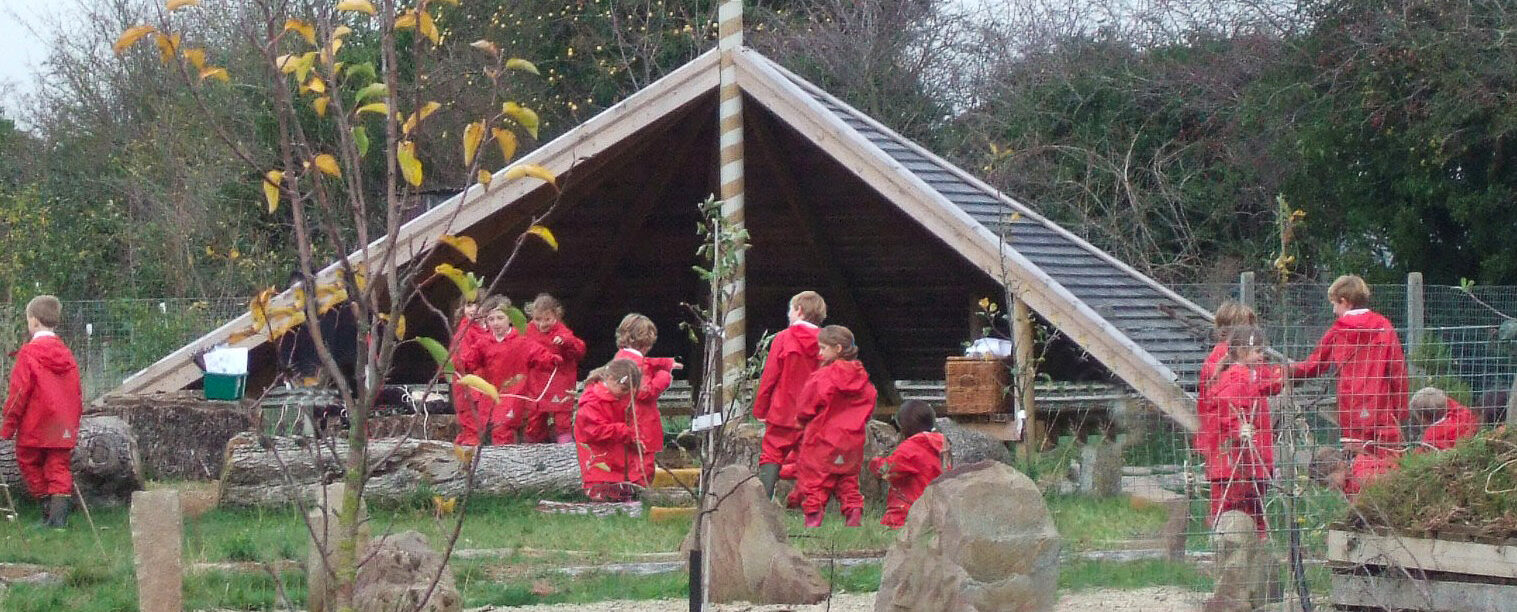
The key to a successful forest school site is access all year round, plus the various infrastructure features that will make your users comfortable outdoors, and excited to be exploring and learning new skills.
Essential Infrastructure
For most sites, the essential requirements are:
All year-round access: a forest school base camp area, plus a main path trail (Nature Trail) with other gathering spaces for whole classes. As winter is the majority of the school year, these areas should all be mud free and accessible in all but the most torrential downpours. The Nature Trail should ideally allow two people to walk together side by side with openings and clearances for larger class gatherings to take place. There may be narrower undeveloped side pathways, for exploration and mini beast safari’s, but the main path trail requires a ‘surface’ to encourage users to walk, collaborate and explore the seasons. There may also be a case, in specific schools, where all year-round access is necessary from the playground to the forest school itself.
Gathering spaces with defined features: these are the outdoor learning environments (OLE) where most activities and shared experiences take place. There may be a central OLE which we call the forest school base camp, or a series of OLE’s dependent on the size of your area: a welcome circle near the entrance, fire circle, storytelling circle etc. A circular sitting area can provide seating for a whole class to interact, listen to stories, or enjoy the magic of an outdoor fire. If you are into outdoor fires, then it is essential that you have firewood storage with dry firewood. See our blog posts Firewood and Storage for Forest Schools and Fires, Woodburners and Cob Ovens for Forest Schools.
Established woodland, orchard or an area with some trees, shrubs and bushes: the forest school curriculum can be taught in an ancient woodland or in something that resembles a domestic garden – there are no specific rules. However, to create ambiance, adventure and exploration, curiosity, screening, passageways & tunnels, nature connections and biodiversity, we need a variety of trees and bushes.
These three elements above will successfully get your forest school up and running. We can then go further, and depending on your resources and budget, the following details can be added to the essential infrastructure.
Add-on Details
These are the wow factors and comfort features:
All weather shelter: particularly useful in English weather, but also practical for taking off and discarding coats and clothing, storing food and drink, another place to spend time etc.
Thresholds, entrances, bridges and tunnels: it’s great to emphasise sections, passageways, and areas within the forest school layout – creating secret gardens, groves, wildflower meadows, willow structures, bird hides, platforms and look-outs, and other unique features.
Woodburners and Cob Ovens: these can be highly effective for winter warmth and can be easier to manage than an outdoor fire. Training is needed to maximise effectiveness, but great for cooking, warming up cold children and general ambiance. We have much experience with advising on such features, and particularly with the cob oven, this is a mud and straw oven which can be created and built with any age groups in a joyously participative process.
Personalisation with artwork and sculpture: chain saw art can really create fine focal points, cost effectively and quickly. And any school artwork can highlight and add sequential interest to paths and gathering spaces. The key is to understand the artwork being created – is it temporary or permanent? If it is temporary, make sure to take it down or replace it once its lifespan has passed.
All forest school sites will be different from one another, but the essential elements remain common to all.